




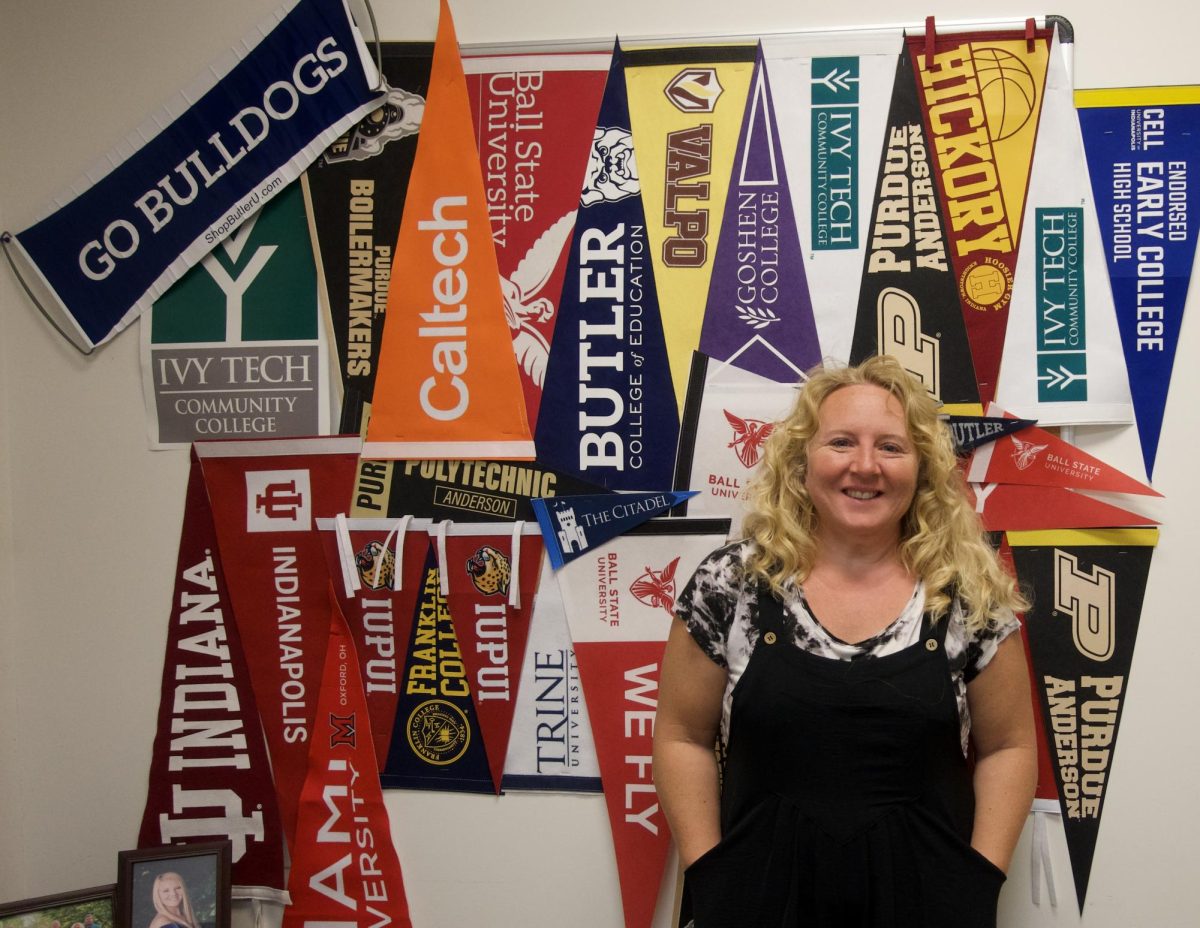












Despite there being efforts to improve education, some students at Anderson begin to fall behind academically. Students facing problems like poor attendance, low SAT scores, or weak college and career readiness may eventually find their way into Terri Wilson’s cramped office off of A hallway.
Going into her 22nd year in education, Terri Wilson, a college and career counselor at Anderson High school helps students fill out FAFSA and college applications, works with students doing 21 Century Scholars, and gives support for anything having to do with a student’s future. Some people may assume that councilors push failing students to drop out so it won’t hurt graduation rates, but Wilson makes sure that that is not the case. “ We don’t ever encourage a student to drop out. And typically, the conversation is kind of opposite,” Wilson said, “Our job as a counselor is to help a student figure out what’s in their best interest.” She believes that a councilor’s job is helping lead students to a path of success.
“So any incoming senior that is behind 20 credits or more, we send over to the Gap program,” Wilson states, “Mrs. Witty is amazing at working with those students and trying to get them caught up and help them graduate on time.” she said. Councilors begin checking on students starting their freshman year. When a student is struggling, they work with them rather than giving up on the student. Wilson and her team have alternative choices that best suit a student’s learning style if regular school isn’t helping them learn best.
Wilson loves to help students, but her favorite part about her job is when students have a “light bulb” moment. “Having that light bulb go off or the motivation all of a sudden hitting you and understanding, like, this is my life,” Wilson said. High school kids are mature enough to realize that their education is important for their future. Having students realize their potential and taking control of their life is the most rewarding experience as a councilor according to Wilson.
At the same time, Wilson’s work can be very draining. Having to check up on hundreds of kids, planning meetings, and hosting events is only a small part of what she does. “Yeah, absolutely. I have some that I have kept in touch with for 20 years,” Wilson states. Despite being overwhelmed, she still manages to keep in touch with some students, some of whom graduated 20 years ago or less.
Even when students face academic challenges, Wilson and other councilors are ready to help students whenever they need it and push them to be successful in whatever they do in the future. Wilson’s interview shows that her and her staff care for their students. While test scores and graduation rates may look like a school is in need of improvement, people working behind the scenes try to open up kids to opportunities, support and encouragement.